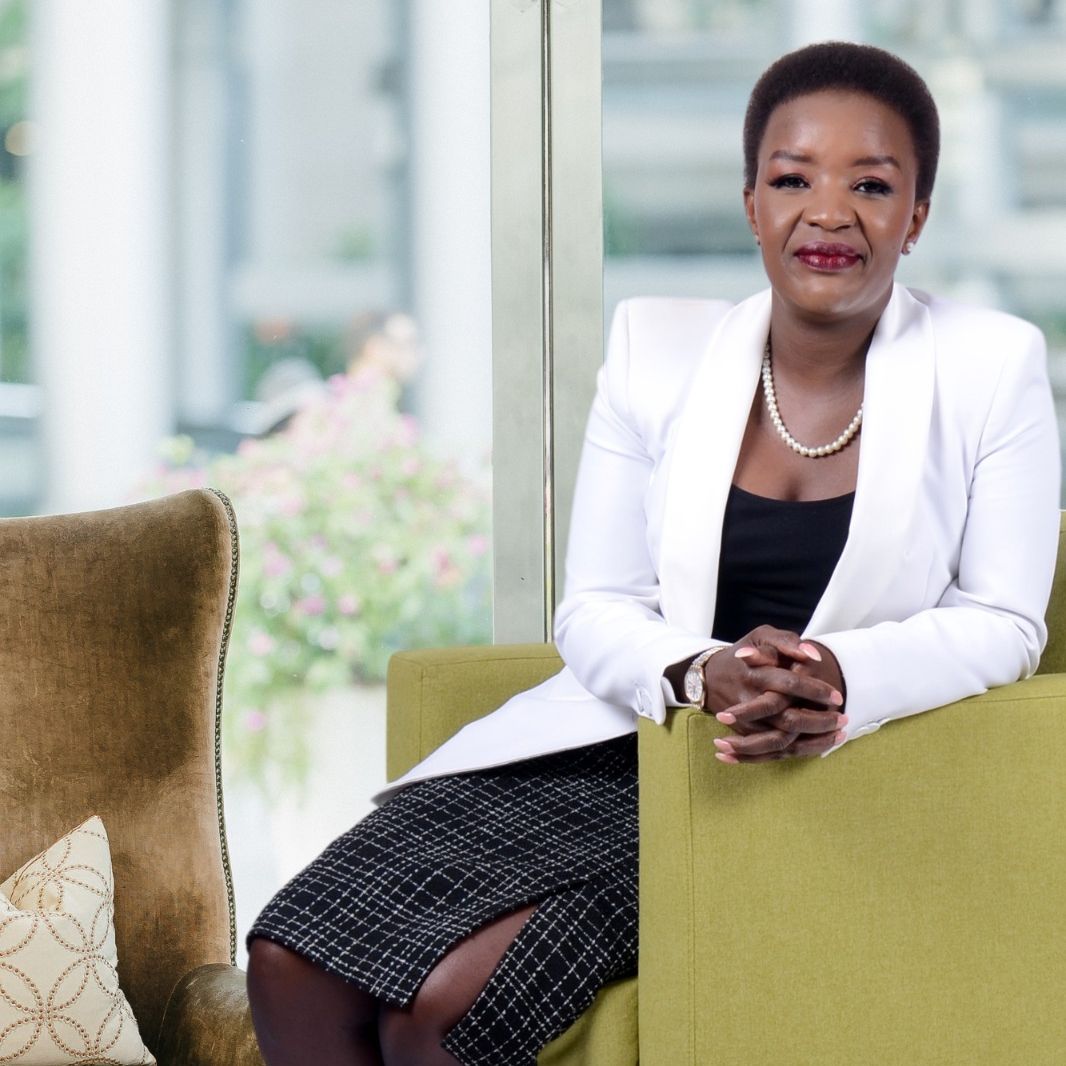
By Prof. Busisiwe Mavuso
One striking insight to emerge from recent global economic discussions has been China’s disciplined commitment to economic pragmatism. As economist Dr Keyu Jin emphasised on her recent trip to South Africa, China’s extraordinary poverty-reduction story was driven by a powerful organising principle: put the economy above politics. That singular focus on growth — despite how controversial some aspects of the Chinese model may be — produced a dramatic developmental shift.
No one is suggesting that South Africa replicate China’s political order. We are a constitutional democracy, and that remains our strength. But we can learn from China’s clarity of purpose. China’s leadership has consistently understood that economic credibility is national credibility. This is something South Africa urgently needs to relearn.
For years, many of us in business have warned that South Africa’s persistent contradiction between economic policy and foreign policy is becoming untenable. We state our desire to attract investment, deepen trade relationships, expand market access, and place our economy on a growth path capable of reducing poverty. Yet our foreign‑policy positions sometimes pull in the opposite direction, undermining policy certainty, which damages investor confidence, and weakening the market access our economy depends on.
In a world where economic interdependence has become a tool of geopolitical leverage, as Canadian Prime Minister Mark Carney recently argued in Davos, middle‑power countries like South Africa must choose their friends carefully and build optionality rather than deepen vulnerability.
We cannot credibly talk about inclusive growth at home while appearing ambivalent about the values and partnerships that sustain our economic prospects abroad.
Another major lesson from China is the importance of a capable and outcomes‑driven state. China’s success did not stem only from capital accumulation or industrial policy. It required a state apparatus able to implement decisions and maintain coherence across institutions. A capable state is the bedrock of development.
South African leaders increasingly acknowledge this. The President, ministers and several senior officials often stress the need for rebuilding state capability. Yet progress remains too slow. Every day brings new reminders of the consequences of a weakened state: failing municipalities, collapsing infrastructure, inadequate service delivery, and transport and logistics bottlenecks. These failures are systemic.
As I have written before, professionalism must start at the top. We need ministers and senior officials who take delivery seriously. And we need public servants who see their role as providing services to the nation rather than an opportunity for patronage. Since the formation of the GNU, we’ve seen great focus and noticeable progress in this area. But all too often, we still encounter incompetence, corruption, indifference, and an entrenched culture of zero accountability.
We know what competent governance looks like. South Africa has delivered world‑class results when operational and technical excellence is prioritised. But these moments are the exception. Until a culture of competence and accountability is embedded in the state, economic reform will continue to be uneven and slow.
China’s pragmatism extends to how it engages the world: diversified partnerships and a clear prioritisation of national interests.
South Africa must internalise this lesson. Our over‑reliance on a few traditional trading partners exposes us to unnecessary geopolitical risk. The volatility in US–SA relations has been a wake‑up call. When your economy is deeply tied to a partner that can, at any moment, deploy trade access, tariffs, and even sanctions as tools of foreign policy, then diversification becomes an economic imperative.
Yet diversification does not mean abandoning existing partnerships. It means balancing them. It means strengthening trade links with regions offering growth potential, such as Southeast Asia, parts of Africa, the Middle East, and Latin America, while maintaining stable relations with our established partners in Europe and North America. It means deepening intra‑African trade under the African Continental Free Trade Area (AfCFTA) and positioning South Africa as a gateway for investment across the continent, something our government rightly highlights.
Middle powers succeed by building diverse networks of cooperation that maximise strategic flexibility, not by choosing sides in global rivalries. Carney is correct: the world has entered a phase of weaponised interdependence, where supply chains, payment systems, market access and even geopolitical alliances can be used as leverage. South Africa cannot assume immunity from these dynamics.
The government’s own messaging underscores the urgency of this argument. In his closing remarks at the 9th South Africa–China Bi-national Commission which took place last week, Deputy President Paul Mashatile celebrated the forum as the “apex mechanism” of bilateral cooperation and pointed to progress in areas ranging from nuclear energy and gas to power development to mineral beneficiation and industrial value addition. He framed these as proof of renewed momentum and shared developmental commitment.
If South Africa is to thrive, we must build a foreign‑policy posture that aligns unambiguously with our economic priorities. That requires consistency and the courage to confront uncomfortable truths.
First, we must recover our credibility as a country committed to rules‑based international engagement, human rights and peaceful cooperation. These are values we have historically championed but have inconsistently applied in recent years.
Second, we must place economic pragmatism at the centre of foreign policy. That means evaluating international positions through the lens of South Africa’s long‑term economic and developmental interests rather than through ideological sentiment or political nostalgia.
Third, we need to use diplomacy to open new markets, strengthen export competitiveness, attract investment and build resilient global partnerships. A country that has battled stagnant growth for over a decade cannot afford foreign‑policy miscalculations that alienate key partners.
Finally, we must invest urgently in state capability. China shows what is possible when a state can coordinate and deliver. South Africa’s own history shows the same. The business community remains ready to partner with government, but partnership cannot compensate indefinitely for dysfunction within the state.
South Africa can continue down a path where political considerations undermine economic priorities and where state incapacity exposes us to unnecessary risk. Or we can choose a path of competence and strategic balance, one that mirrors the pragmatic lessons we see from China and resonates with the message Carney is offering to middle powers across the world.
The world is changing fast. The countries that will thrive are those that recognise reality early and adapt with purpose. South Africa has the talent and institutions to be one of them. But we must act with the single-minded understanding that economic strength is the foundation of national strength. And that work must begin now.