By Zamaphathwa Phathwa
BA Law & Politics Graduate | Legal Writer & Commentary on Public Accountability | Future Prosecutor | Criminal Law & Justice Researcher | Academic Tutor
LEGAL LENS – Your legal friend explaining the law clearly, critically, and without the noise.
Introduction: The Career Story We Were All Told
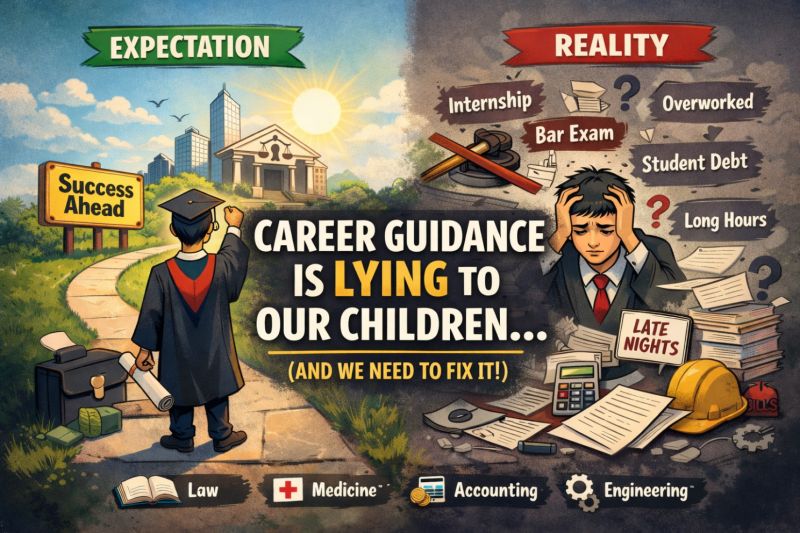
For years, learners have been told a simple story: study hard, go to university, get a degree, and success will follow. It sounds neat. Motivational, even. Unfortunately, it is also incomplete.
Many graduates only discover too late that a degree is not the final destination but merely the first checkpoint. Careers such as law, medicine, accounting, and engineering require additional training, professional exams, accreditation, and years of training before actual practice begins. The shock that follows is not a personal failure; it is a systemic one.
Defining the Problem: Career Guidance vs Career Reality
Career guidance
Career guidance typically focuses on subject choices, university applications, and entry requirements. In other words, it answers the question: “What can I study after matric?”
Career reality education
Career reality education goes further. It answers the more important question: “What will my life actually look like if I choose this career?”
This includes:
the full qualification pathway
post-degree training requirements
professional examinations
timeframes and costs
employment prospects and competition
alternative career options.
South Africa largely offers the former while neglecting the latter.
Why Career Expos Are Not Enough
Career expos are often presented as the solution to career uncertainty. In reality, they are a partial and unequal intervention.
Limited access
Career expos are frequently hosted in urban centres, require transport, and are not accessible to all schools, particularly those in rural or under-resourced areas. As a result, the learners who most need guidance are often excluded.
Assumption of prior knowledge
Career expos rely on the idea that learners will ask questions. However, expecting an 18-year-old, fresh out of matric, to ask technical questions about professional accreditation or post-degree requirements is unrealistic. One cannot ask the right questions about a career one has never been properly introduced to.
Surface-level engagement
Most career expos offer brochures, slogans, and general encouragement. Rarely do they provide honest discussions about:
How long does a qualification truly takes
How competitive entry into professions is
the financial burden beyond tuition
The number of graduates who never enter practice
Students leave inspired but uninformed, and inspiration without information often leads to disappointment.
The Consequences of Poor Career Reality Education
South Africa already faces severe youth unemployment. According to Statistics South Africa, young graduates experience high levels of unemployment and underemployment, despite holding formal qualifications (Stats SA, 2023).
When students enter degrees without understanding professional realities, the result is:
extended periods of study
financial strain
delayed career entry
feelings of personal failure for systemic shortcomings
The issue is not ambition—it is misinformation.
What the Government Needs to Do
A nationally standardised programme
Career reality education must be formalised as a national programme, coordinated by the Department of Basic Education and the Department of Higher Education and Training.
This programme should:
begin in Grade 11
continue into first-year tertiary education
be career-specific
be offered multiple times per year
be automatically accessible (no applications or selection criteria)
Career information should be treated as a public good, not a privilege.
Law as a Case Study
Law is a prime example of why career reality education matters. Many students believe that completing a law degree leads directly to becoming a lawyer. In practice, the pathway includes:
different types of law degrees with different outcomes
articles of clerkship or pupillage
professional examinations
admission procedures
long waiting periods before practice.
Without early explanation, students are left confused and discouraged. Clear, early guidance would prevent unrealistic expectations and unnecessary attrition.
The Legal and Policy Dimension
Meaningful access to education includes access to accurate and sufficient information. An education system that prepares learners academically but not professionally undermines:
the right to education
human dignity
youth development objectives
national skills development goals.
The state is not required to guarantee employment, but it is required to ensure that educational pathways are transparent and understandable.
The Role of the Private Sector
Private companies and professional bodies benefit from skilled graduates and must therefore contribute to preparing them. This includes:
collaborating across industries
participating in structured career reality programmes
sharing realistic expectations of entry-level work
providing honest data, not marketing slogans
Career development should be a collective responsibility, not a branding exercise.
Making Career Education Enjoyable in Schools
Career education does not need to be dull or intimidating. Schools can:
Use career simulations
Invite alumni to speak honestly about challenges.
encourage open questions without judgment
normalise uncertainty and exploration
A simple truth applies: there are no stupid questions, only systems that explain too little.
Conclusion: From Movie Trailers to Instruction Manuals
A degree is not a magic wand. Graduation is not the finish line; it is the starting gun.
If South Africa is serious about youth development and graduate employability, it must move beyond motivational talks and career expos. Students deserve clear, honest, and accessible explanations of the careers they are expected to build.
It is time to stop selling careers like movie trailers and start explaining them like instruction manuals.