
By Zamaphathwa Phathwa
LEGAL LENS – Your legal friend explaining the law clearly, critically, and without the noise.
South Africa does not create boring political dramas. We create full-blown constitutional thrillers.
And right now, the Madlanga Commission is centre stage.
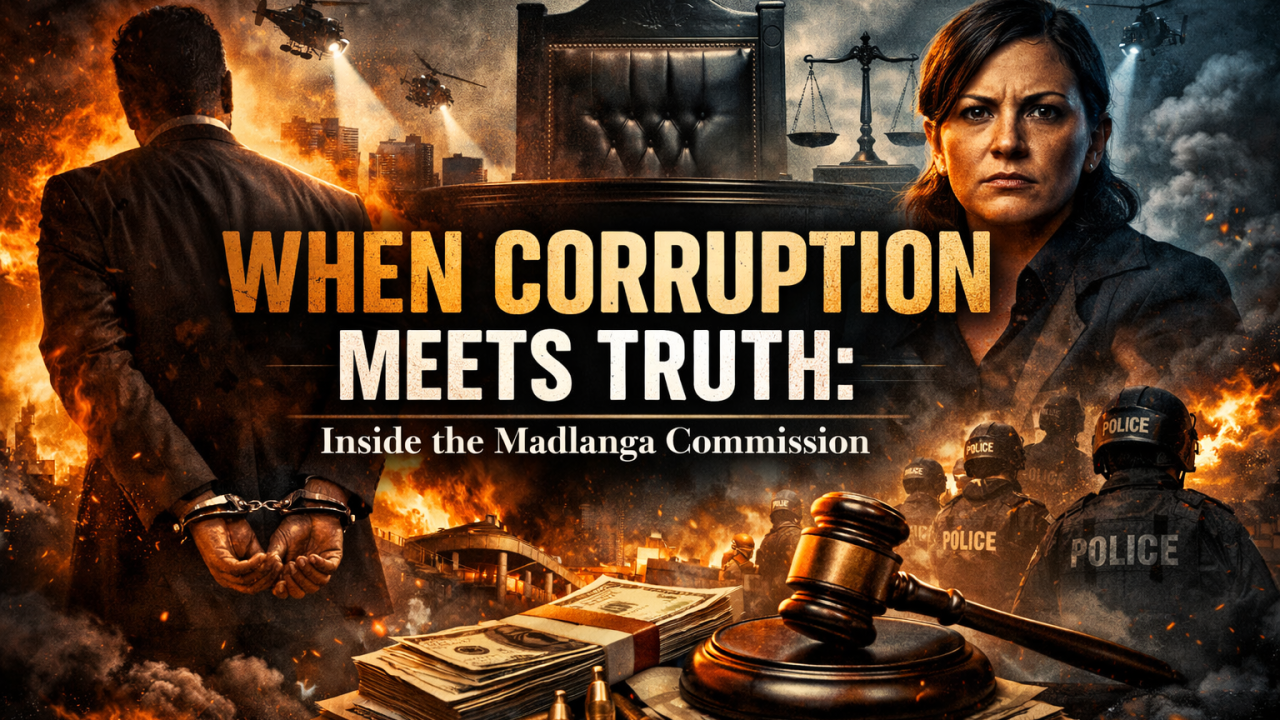
Named after retired Constitutional Court Justice Mbuyiseli Madlanga, this Judicial Commission of Inquiry was established by President Cyril Ramaphosa in 2025 to investigate allegations of criminality, political interference, and corruption within the criminal justice system (Government of South Africa, 2025).
Translation?
This is not about petty misconduct. This is about whether organised crime has penetrated the very institutions meant to fight it.
And that is not a small accusation.
Why This Commission Exists
The spark came from KwaZulu-Natal Police Commissioner Nhlanhla Mkhwanazi, who publicly alleged that:
- Senior political actors interfered with police investigations.
- A specialised Political Killings Task Team was undermined
- Criminal syndicates may influence state structures
Those are not technical complaints. Those are systemic corruption allegations.
Once a senior provincial commissioner makes claims that high-level interference is protecting criminal networks, the President cannot ignore it. Hence, the commission.
This is constitutionally significant because under section 84(2)(f) of the Constitution, the President may appoint commissions of inquiry. These bodies gather evidence under oath, subpoena witnesses, and produce recommendations. They do not prosecute, but they can open the door to prosecution.
Who Has Testified and Why It Matters
Let’s break it down properly.
🔹 Mkhwanazi
He didn’t whisper. He accused.
He alleged that investigations into politically sensitive killings were disrupted and that efforts to combat organised crime were frustrated from within the system (Madlanga Commission Proceedings, 2025).
That’s not “office politics.” That’s institutional sabotage if proven.
🔹 Fannie Masemola
As National Police Commissioner, his testimony carried weight.
He addressed the restructuring and disbandment of units dealing with political killings and responded to claims of interference (SAPS Briefing, 2025).
When the national head of SAPS is testifying in a commission about internal dysfunction, you know we are not in normal times.
🔹 Dumisani Khumalo
Crime Intelligence testimony introduced allegations of a syndicate referred to as the “Big Five” linked to drug trafficking, tender manipulation, and organised criminal activity (Commission Records, 2025).
Again: these are allegations.
But allegations made under oath.
And that changes everything.
🔹 Vusimuzi Matlala
Matlala’s name surfaced in relation to alleged criminal networks and business dealings that intersect with political actors (Media Reports, 2025).
Important legal point: appearing in commission evidence does not equal guilt. A commission is investigative, not adjudicative. Due process still applies.
But where there is smoke, the public is entitled to ask whether there is fire.
The “Angry Woman” Debate Let’s Be Honest
There has been public commentary about one female evidence leader/commission questioner, criticised for being aggressive, sharp, and even confrontational.
Let’s be serious for a moment.
This is not a book club. This is not couples therapy.
This is a judicial inquiry into alleged corruption involving powerful individuals.
Cross-examination is not supposed to feel warm and friendly. It is supposed to test credibility. It is supposed to probe inconsistencies. It is supposed to expose contradictions.
When lawyers question potential architects of systemic corruption, they are not there to hand out emotional comfort.
Expecting softness in that setting misunderstands the purpose of legal interrogation.
The Commission’s mandate is truth-seeking. Truth-seeking is uncomfortable.
Where Things Stand Now
As of early 2026:
- The Commission continues hearing testimony.
- Digital evidence (including communication records) forms part of the evidentiary landscape.
- Parallel parliamentary processes have begun examining related governance issues.
- No final report has yet been issued.
This matters because commissions like this often shape:
- Criminal investigations
- Policy reform
- Institutional restructuring
- Public trust (or further erosion of it)
South Africa has been here before. The Zondo Commission taught us that commissions can expose deep systemic rot. The difference now is that the focus is on the criminal justice system itself.
If the institution meant to enforce the law is compromised, that is not just corruption.
That is a constitutional risk.
The Legal Reality
Let’s ground this.
A commission:
- Does not convict.
- Does not sentence.
- Does not replace courts.
But it can recommend prosecution. It can recommend disciplinary action. It can recommend structural reform.
And its findings often influence the National Prosecuting Authority.
So when people treat this as “political drama,” they miss the legal consequence pipeline that follows.
Evidence → Report → Recommendations → Investigations → Possible Charges.
That is the chain.
The Bigger Question
The real issue is not personalities.
It is this:
If organised criminal interests have infiltrated state institutions, how deep does it go?
And if interference in investigations occurred, who benefits?
These are not partisan questions. They are constitutional ones.
The rule of law either applies upward to the powerful or it is a slogan.
Final Word
The Madlanga Commission is not entertainment. It is an X-ray of our criminal justice system.
If nothing comes of it, public trust weakens further.
If something does come of it, the consequences could reshape policing, intelligence oversight, and political accountability in this country.
Either way, pretending this is small would be dishonest.
And Legal Lens does not do dishonesty.
Reference
- Commission Records (2025) Judicial Commission of Inquiry into Criminality, Political Interference and Corruption in the Criminal Justice System: Public Hearings. Pretoria: Government of South Africa.
- Government of South Africa (2025). Establishment of the Madlanga Commission of Inquiry. Pretoria: Presidency of the Republic of South Africa.
- Madlanga Commission Proceedings (2025) Testimony of Lieutenant General N. Mkhwanazi. Pretoria.
- SAPS Briefing (2025) Testimony of National Commissioner F. Masemola before the Commission. Pretoria.
- Media Reports (2025): Various national coverage on commission proceedings and individuals mentioned in testimony.