With petrol at R26.63 a litre in Gauteng and diesel up R6.19/l from 7 May 2026, the total cost of owning a car has never looked more punishing. For many South Africans, switching to a two-wheeler could be the smartest financial move of 2026.
Opinion by Robin van Rensburg, Managing Director of The Nexus Collective
South African motorists are already feeling the squeeze. April’s massive fuel price increases drove a 35% drop in fuel purchases compared to March – a striking signal that consumers are changing their driving behaviour, combining trips, driving less, and rethinking every journey.
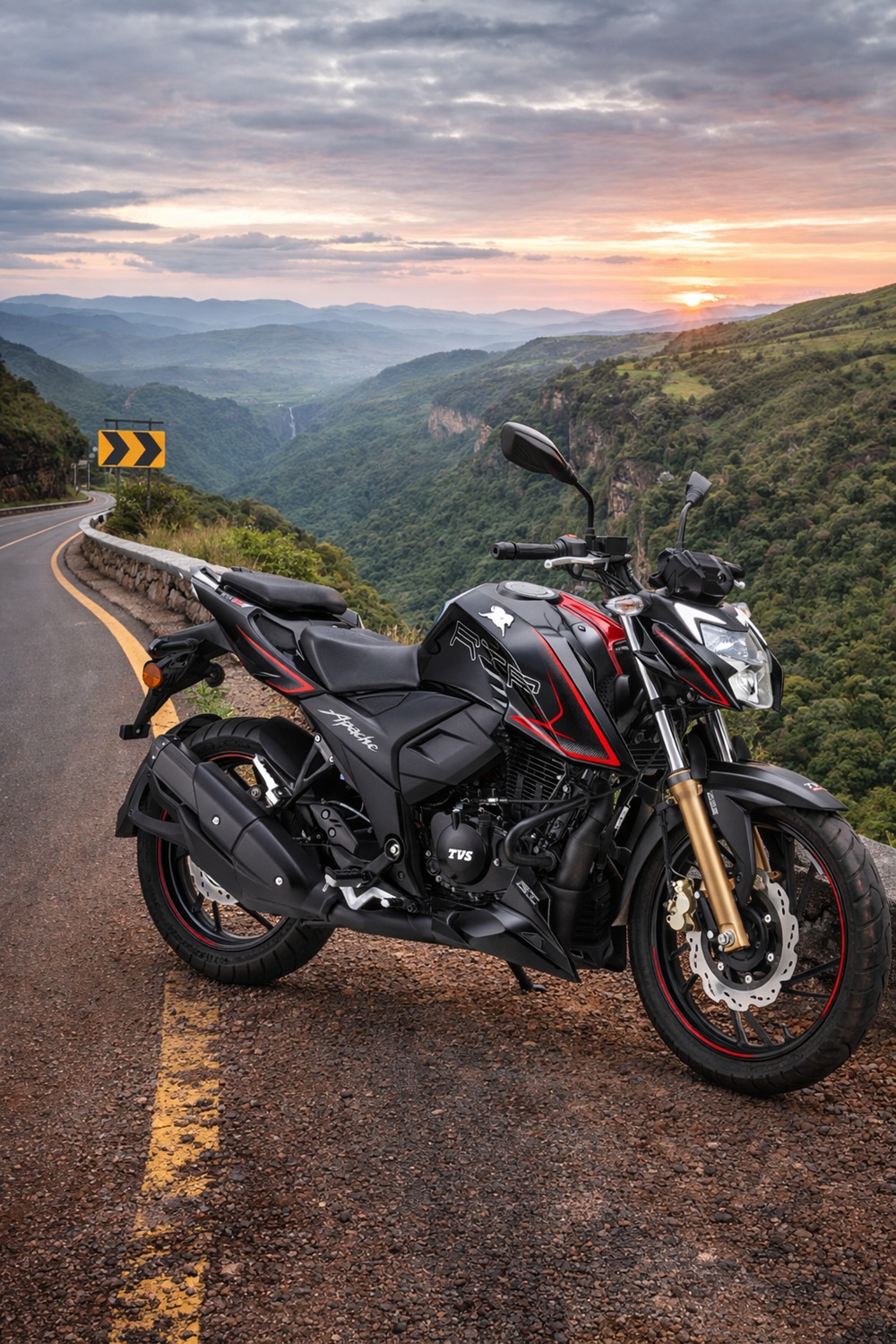
But cutting trips can only go so far. For those open to a more fundamental shift, a commuter motorbike – think a TVS TVS Ntorq 125 RE Scooter, TVS Star HLX 125 or the popular TVS TVS Apache RTR 200 4V – offers a genuinely transformative restructuring of total monthly transport costs.
The comparison below on the TVS Apache RTR 200 4V isn’t just about fuel. It spans every rand spent from the day you drive off the lot to the day you sell – purchase price, insurance, maintenance, tyres, and licensing. When you account for all of it, the financial gap is startling.
The Apache RTR 200 4V at a glance
The Apache RTR 200 4V is a proper 197.75cc, oil-cooled, fuel-injected sports commuter with dual-channel ABS, race-tuned suspension, riding modes and a top speed of 127km and priced at R44,999 new. The comparison below pits the Apache RTR 200 4V against a budget entry-level hatchback at approximately R220,000. Both serve the urban commuter doing around 1,500 km per month. The difference in monthly outlay is not subtle.
The numbers: what ownership actually costs
| Entry hatchback |
| Purchase price: R220,000 |
| Monthly finance (60 mo): R4,800 |
| Fuel (1,500 km @ 6.5 l/100): R2,600 |
| Comprehensive insurance: R1,100 |
| Annual service (prorated): R600 |
| Tyres (prorated): R300 |
| Licence & registration: R130 |
| Est. monthly total: R9,530 |
| TVS Apache RTR 200 4V |
| Purchase price: R44,999 |
| Monthly finance (48 mo): R1,250 |
| Fuel (1,500 km @ 2.6 l/100): R1,040 |
| Comprehensive insurance: R380-R500 |
| Annual service (prorated): R150 |
| Tyres (prorated): R100 |
| Licence & registration: R80 |
| Est. monthly total: R3,000 |
(Figures are indicative estimates based on South African market data at time of publication. Apache RTR 200 4V retail price R44,999 as at May 2026. Fuel cost calculated at R26.63/l (Gauteng 95 Unleaded, effective 7 May 2026). Real-world fuel consumption based on owner-reported average of 38 km/l. Finance costs assume prime-linked retail rates. Individual costs will vary based on rates applied.)
Fuel: where the Apache is exceptional
The Apache RTR 200 4V’s fuel injection and oil-cooled 197.75cc engine return a real-world average of approximately 38 km per litre – translating to just 2.6 litres per 100 km in mixed riding. At R26.63 per litre, covering 1,500 km in a month costs the Apache rider roughly R1,040 in fuel. The same distance in a typical entry-level hatchback, at 6.5 l/100 km, costs R2,600 – 2.5 times more, for identical kilometres travelled. Annualised, that fuel gap alone amounts to approximately R18,700. Over a five-year ownership period, the Apache RTR 200 4V saves its rider over R93,000 in fuel costs versus the equivalent car – before a single rand of finance, insurance, or maintenance savings is counted.
Insurance: a fraction of the car premium
Comprehensive car insurance on an entry-level hatchback typically runs R900–R1,400 per month in Gauteng, depending on your suburb, age, and claims history. The Apache RTR 200 4V, with a retail value of R44,999, attracts a comprehensive premium of roughly R300 – R450 per month. The liability and replacement cost footprint is simply smaller, and insurers price accordingly.
For riders comfortable with the risk, third-party cover on a R44,999 motorcycle can be obtained for as little as R150–R200 per month – making the insurance gap versus a car even more pronounced. At the opposite end, even a fully comprehensive, zero-excess policy on the Apache costs less than the most basic car insurance plan available.
Service and maintenance: a well-engineered machine kept simple
TVS has built a meaningful dealer network across South Africa through the Bidvest Group, giving Apache owners solid access to genuine parts and trained technicians. A standard service on the RTR 200 4V – oil, filter, spark plug, and labour – typically costs R800–R1,200, and the service intervals are generous. Compare that to R3,000–R6,000 for a car service on a manufacturer-specified schedule, and the annual saving on maintenance alone runs to R2,000–R4,000.
Tyres reinforce the picture. A front-and-rear set for the Apache runs R800-R1,800. The equivalent replacement for a compact hatchback costs R2,500–R5,000, and the larger contact patch of a car means they wear at a broadly comparable rate to motorbike rubber on a commuter application.
More than a budget choice
It is worth emphasising that the Apache RTR 200 4V is not a spartan economy machine chosen purely to save money. It comes with race-tuned Showa forks, a slipper clutch, dual-channel ABS, riding modes (Sport, Urban, Rain), SmartXonnect Bluetooth connectivity, and a top speed of 127 km/h. It is a motorcycle that costs less to own than a budget hatchback while offering considerably more engagement to ride.
A two-wheeler is not for everyone. But for the urban or peri-urban commuter who drives primarily alone, on predictable routes, within roughly 40-60 km of home, the financial case is overwhelming. The practical trade-offs – reduced carrying capacity, weather exposure, less protection in a collision – are real, and riders must weigh them honestly. Rider training and a quality helmet are non-negotiable costs that responsible ownership demands.
That said, for someone currently spending R8,000 – R10,000 a month keeping a car on the road, a transition to a quality commuter motorbike and an occasional car-hire or ride-share for family trips can cut total transport spend by 50–65%. At a time when real household incomes are under sustained pressure, that is not a marginal efficiency gain – it is a meaningful shift in financial breathing room.
South Africans have historically viewed the car as a social necessity as much as a practical one. Rising fuel prices, rising insurance premiums, and rising interest rates are quietly but forcefully revising that calculation. The 35% drop in April fuel purchases is not a blip – it is the beginning of a structural rethink. For those with the flexibility to embrace it, two wheels may be the most rational financial decision available in 2026.